

Totally Accurate Battlegrounds – Physics Absurdity, Unreliable Skill, and the Joy of Losing Control
Introduction: A Battle Royale That Refuses to Behave
Totally Accurate Battlegrounds (TABG) looks like a joke—and that is precisely the point. In a genre defined by seriousness, optimization, and mechanical precision, TABG deliberately undermines player control, predictability, and mastery. It replaces tight gunplay with wobble physics, consistent recoil with chaos, and clean silhouettes with flailing limbs. Yet beneath the absurd exterior lies a surprisingly thoughtful design that interrogates what skill even means in competitive games.
This review treats Totally Accurate Battlegrounds not as parody for parody’s sake, but as a system-driven experiment in uncertainty. We will examine how physics-based movement, inconsistent weapons, emergent storytelling, and social psychology converge to create a battle royale that is funny, frustrating, and quietly insightful.
Quick Info (Overview Box)
Release Year: 2021
Genre: Battle royale / Physics-based shooter
Platforms: PC
Game Modes: Solo, Duo, Squad, Limited-time modes
Target Audience: Players who enjoy chaotic multiplayer, emergent humor, and games that prioritize moments over mastery
1. Design Intent: Comedy as a System, Not a Skin
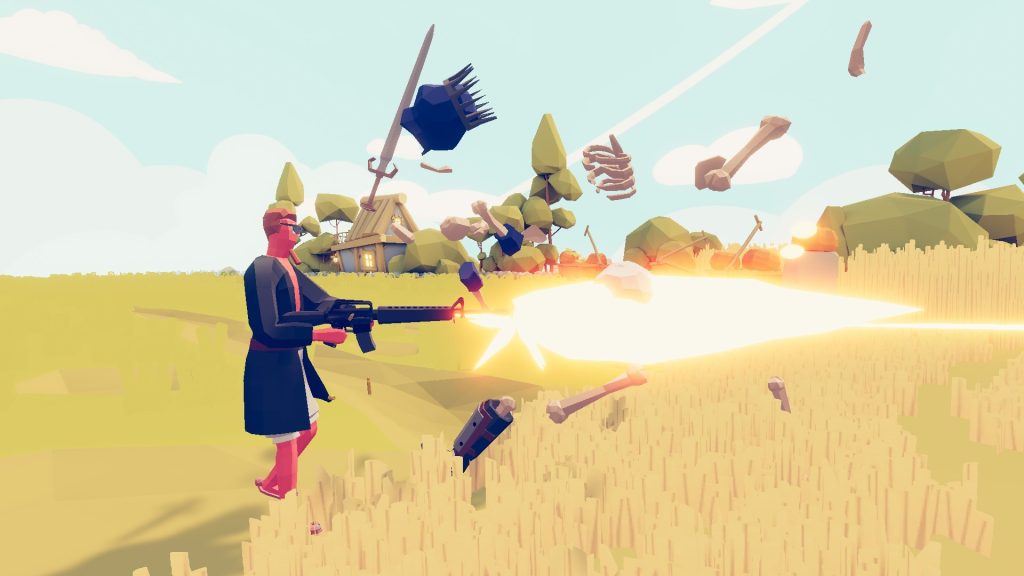
At first glance, Totally Accurate Battlegrounds appears to be a slapstick reskin of conventional battle royale design. The exaggerated ragdoll bodies, flopping arms, and googly-eyed expressions suggest satire. But comedy here is not cosmetic—it is systemic.
The game’s physics engine actively resists player intention. Aiming is imprecise. Movement is unstable. Recoil behaves like a living thing. These elements are not bugs; they are the core mechanics. By removing reliability, TABG reframes competition around adaptation rather than execution.
This design decision challenges a foundational assumption of shooters: that skill should be expressed through consistency. TABG argues the opposite—skill can also be expressed through improvisation.
2. Movement: When Your Body Is the Enemy
Movement in Totally Accurate Battlegrounds is an ongoing negotiation with gravity, momentum, and your own limbs. Characters stumble, trip, and flail, turning even simple traversal into a minor ordeal.
This has a profound effect on pacing. Sprinting is risky. Jumping can be catastrophic. Verticality becomes dangerous rather than advantageous. Players learn to respect terrain not because it offers cover, but because it threatens humiliation.
Interestingly, this creates a subtle skill curve. Experienced players do not move faster—they move safer. They learn how to manage momentum, how to fall without tumbling, and how to recover from mistakes. Mastery exists, but it is fragile.
3. Gunplay Without Trust
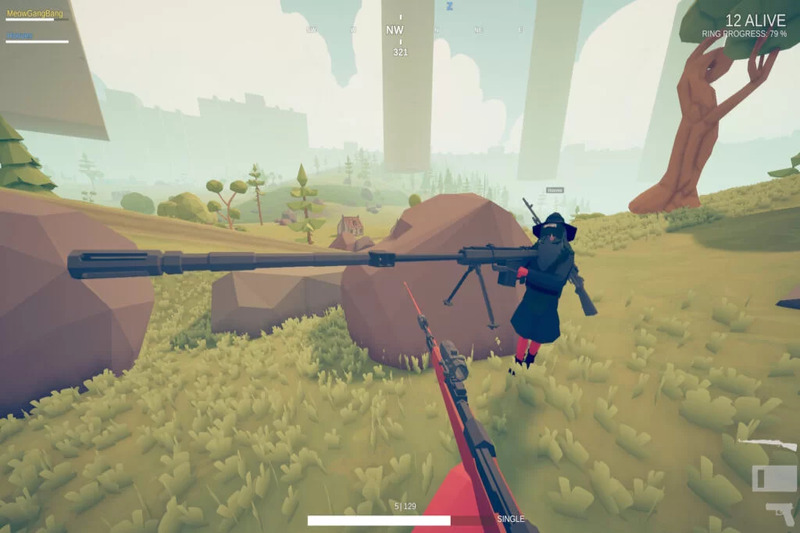
Traditional shooters reward muscle memory. Totally Accurate Battlegrounds actively undermines it. Weapons sway unpredictably, recoil feels elastic, and attachments often exaggerate instability rather than reduce it.
This means gunfights are rarely clean. Victory often goes to the player who adapts quickest to the current nonsense rather than the one with the best aim. A player might miss five shots at point-blank range, then accidentally land a perfect headshot mid-fall.
The result is a constant tension between intent and outcome. You are always trying to play well, but the game refuses to confirm that effort reliably. This is where frustration turns into humor—or rage—depending on temperament.
4. Loot Design: Power Without Precision
Loot in Totally Accurate Battlegrounds follows battle royale conventions—guns, attachments, armor—but with a twist. Items rarely feel balanced in the traditional sense. Some weapons are absurdly powerful but nearly unusable. Others are weak but stable.
This creates a fascinating loot psychology. Players are not just choosing strength; they are choosing risk. Do you take the wildly inaccurate high-damage weapon and hope physics cooperates, or do you choose a modest gun that behaves?
The loot system reinforces the game’s core message: control is an illusion. You are not building a perfect loadout—you are assembling a survival kit for chaos.
5. The Map: A Stage for Emergent Comedy
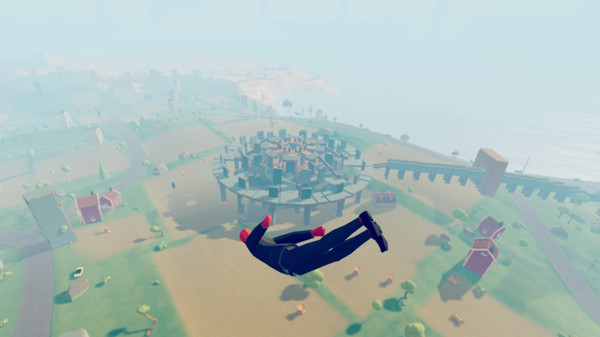
TABG’s map design is intentionally readable and uncluttered. This clarity ensures that when things go wrong—and they often do—it is obvious why. You can see the hill you rolled down, the ledge you failed to climb, the doorway you got stuck in.
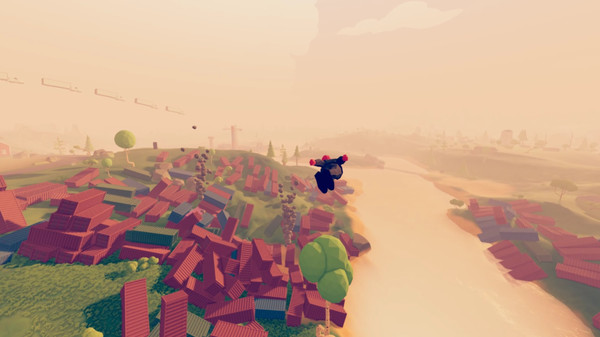
Open spaces amplify movement chaos, while urban areas create slapstick collisions. The map is less a tactical chessboard and more a physical comedy stage.
Because of this, matches generate stories effortlessly. Not because the game tells them, but because players remember how they failed. TABG excels at creating moments worth retelling.
6. Player Psychology: Coping With Unfairness
One of the most interesting aspects of Totally Accurate Battlegrounds is how it forces players to confront their relationship with fairness. The game is unapologetically unfair—at least on the surface.
Shots miss for reasons that feel arbitrary. Characters fall for reasons that feel undeserved. Victory can feel accidental. This strips away the protective narratives players often use to rationalize loss.
Those who stay with TABG learn a different mindset: success is temporary, failure is funny, and control is overrated. The game quietly trains emotional resilience by refusing to validate ego.
7. Social Play: Shared Absurdity
In squad modes, Totally Accurate Battlegrounds becomes a social comedy engine. Teammates collide, sabotage each other unintentionally, and die in spectacular fashion.
Communication shifts from callouts to laughter. Planning gives way to reactive chaos. Importantly, blame dissolves. When everyone knows the game is ridiculous, mistakes feel communal rather than personal.
This makes TABG uniquely effective as a social game. It lowers the emotional stakes of competition and replaces them with shared experience.
8. Skill Expression in a Broken World
Despite appearances, Totally Accurate Battlegrounds does have a skill ceiling. It is simply unconventional. Skilled players:
Control momentum better
Choose safer engagements
Understand weapon quirks
Adapt faster under pressure
However, this skill expression is always unstable. Even experts fail frequently. This keeps the power gap narrow and prevents dominance from becoming oppressive.
TABG does not eliminate skill—it humiliates it. And in doing so, it democratizes competition.
9. Longevity Through Unpredictability
Most multiplayer games rely on content updates to stay relevant. Totally Accurate Battlegrounds relies on unpredictability. Because outcomes are never fully controllable, repetition feels less repetitive.
Matches blur together mechanically but stand apart emotionally. You may forget who won, but you remember how you lost.
This gives the game a peculiar form of longevity. It is not endlessly deep, but it is endlessly surprising.
10. TABG in the Battle Royale Ecosystem
Within the broader battle royale genre, Totally Accurate Battlegrounds occupies a strange niche. It is not competitive in the esports sense. It is not cinematic. It does not aspire to realism or balance.
Instead, it acts as a critique of the genre’s obsessions with optimization and seriousness. It asks: what if losing was as entertaining as winning? What if control was optional?
In that sense, TABG is less a competitor and more a commentary.
Pros
Genuinely unique physics-driven gameplay
Emergent humor creates memorable moments
Low emotional toxicity compared to serious shooters
Accessible to players of varying skill levels
Strong social and party-game appeal
Cons
Inconsistency can feel frustrating rather than funny
Limited depth for players seeking mastery-driven competition
Gunplay may feel unsatisfying to precision-focused players
Visual style and humor may not appeal to everyone
Smaller community compared to mainstream battle royales
Conclusion: A Game About Letting Go
Totally Accurate Battlegrounds is not about being the best. It is about surviving nonsense with grace—or at least with laughter. By weaponizing physics and uncertainty, it challenges the assumption that competitive games must be precise to be meaningful.
For players who are tired of optimization, rankings, and emotional pressure, TABG offers something rare: permission to fail loudly and often. It is a reminder that games can be competitive and ridiculous, stressful and joyful.
You do not play Totally Accurate Battlegrounds to prove skill.
You play it to discover what happens when skill stops behaving.