
Counter-Strike 2: Precision, Trust, and the Burden of Competitive Purity
Introduction: When a Game Refuses to Be Reinvented
Counter-Strike 2 exists under a unique kind of pressure. It is not expected to surprise, reinvent, or redefine its genre. Instead, it is expected to preserve something fragile: a competitive language that millions of players already speak fluently. In a landscape where sequels often justify themselves through novelty, Counter-Strike 2 justifies itself through continuity.
This is not a game about discovery. It is a game about refinement. Every design choice in Counter-Strike 2 is measured against one question: does this preserve competitive integrity? That question shapes everything—from gunplay to map design to how players perceive fairness, blame, and improvement. This review approaches Counter-Strike 2 not as a product upgrade, but as a philosophical statement about what competitive games should value in an era obsessed with change.
Quick Info (Overview Box)
Release Year: 2023
Genre: Tactical first-person shooter
Platforms: PC
Game Modes: Competitive, Premier, Casual, Deathmatch, Custom Games
Target Audience: Competitive FPS players who value precision, consistency, and long-term skill mastery

1. Core Identity: A Game About Trust
At its core, Counter-Strike 2 is a game about trust. Players trust that bullets behave consistently, that maps are readable, that outcomes are explainable, and that improvement is earned rather than granted.
This trust is fragile. Any randomness that cannot be learned, predicted, or mitigated erodes the game’s foundation. Counter-Strike 2 understands this deeply. It does not chase accessibility at the expense of clarity. It does not dilute mechanics to accommodate spectacle.
Instead, it reinforces a simple promise: if you lose, there is a reason—and if you improve, it will matter.
2. Gunplay: Consistency as a Skill Contract
Gunplay in Counter-Strike 2 remains intentionally unforgiving. Recoil patterns demand memorization. First-bullet accuracy rewards discipline. Movement penalties are absolute.
This is not accidental harshness. It is a contract between the game and the player. Learn the rules, and the game will never betray you. Ignore them, and the game will punish you without apology.
What makes Counter-Strike unique is that mastery feels mechanical rather than statistical. There are no perks, abilities, or modifiers to soften mistakes. You are responsible for every bullet fired—and every bullet missed.
3. Movement: Constraint as Design
Movement in Counter-Strike 2 is intentionally limited. There is no sliding, wall-running, or advanced traversal. Speed is capped. Momentum is controlled. Silence requires sacrifice.
This restraint amplifies tension. Because movement options are limited, positioning becomes critical. Every step carries risk. Every sound has consequence.
The absence of mobility mechanics forces players to think spatially rather than kinetically. You do not escape danger by moving faster—you escape it by being smarter beforehand.
4. Maps as Competitive Instruments
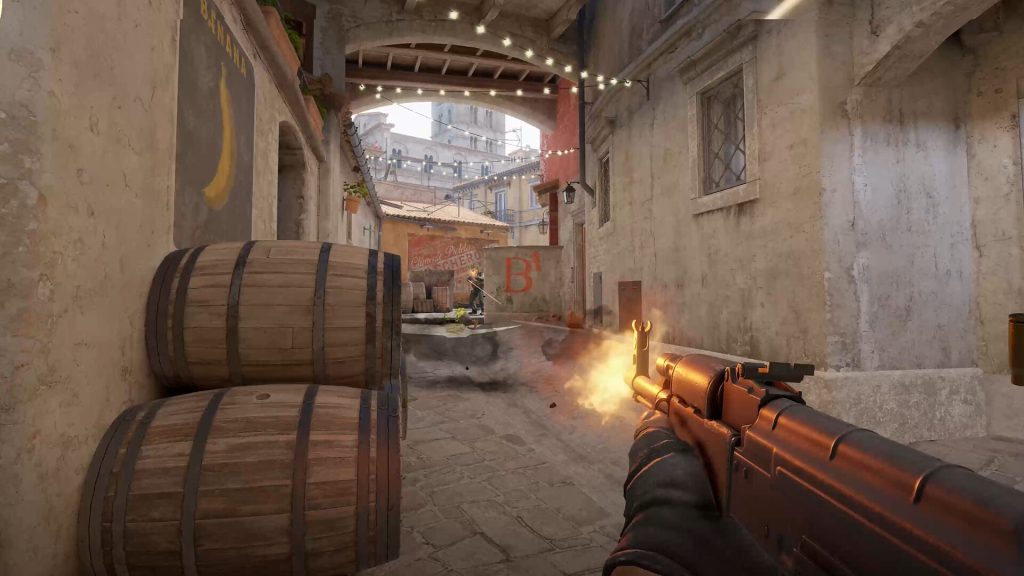
Maps in Counter-Strike 2 are not playgrounds; they are instruments. Every angle, choke point, and sightline exists to create repeatable, testable interactions.
Good maps in Counter-Strike are readable without being simplistic. They reward map control, utility usage, and timing over improvisation. Familiarity breeds confidence—but also predictability.
The brilliance of the design is that mastery never eliminates risk. Even on a map you know intimately, one mistake can unravel an entire round.
5. Utility: Knowledge Over Reflex
Grenades in Counter-Strike 2 are not optional tools—they are extensions of strategy. Smokes, flashes, molotovs, and HE grenades define the tempo of rounds.
Learning utility is less about execution and more about understanding why it works. A well-timed smoke denies information. A poorly placed flash blinds teammates. Utility is power only when paired with intent.
This reinforces the game’s intellectual dimension. Mechanical aim matters—but rounds are often won before shots are fired.
6. Economy: Long-Term Thinking Under Pressure
The economy system in Counter-Strike 2 transforms each match into a layered strategic exercise. Winning a round inefficiently can weaken future rounds. Losing wisely can preserve momentum.
This forces teams to think beyond the immediate moment. Decisions are not isolated; they ripple forward. Players must balance greed against survival, confidence against restraint.
The economy is where Counter-Strike reveals its chess-like depth. Individual brilliance matters—but discipline wins championships.
7. Time-to-Kill and Psychological Weight
Counter-Strike’s low time-to-kill defines its emotional texture. Gunfights end quickly. Mistakes are irreversible. There is no opportunity to recover once a duel is lost.
This creates immense psychological pressure. Players hesitate, overthink, and second-guess. Confidence fluctuates round by round.
What makes this sustainable is fairness. When death comes instantly, it feels harsh—but rarely arbitrary. The game’s clarity allows players to internalize failure rather than resent it.
8. Teamplay: Information as Currency
Communication in Counter-Strike 2 is not social—it is transactional. Callouts, timings, and utility coordination determine success more than raw mechanics.
A single piece of information—enemy position, utility usage, rotation timing—can swing an entire round. Silence is often deadlier than poor aim.
This makes Counter-Strike emotionally demanding. Team chemistry, trust, and composure matter as much as skill. The game exposes interpersonal dynamics under stress with ruthless efficiency.
9. Competitive Systems and Player Accountability
Ranked and Premier modes in Counter-Strike 2 emphasize accountability. Progress is slow. Plateaus are common. Improvement is incremental.
There are no artificial dopamine systems to mask stagnation. If you stop learning, you stop climbing. This honesty is both the game’s strength and its barrier.
Players who seek constant affirmation may struggle. Players who seek mastery find something rare: a system that respects their time by refusing to lie.
10. Counter-Strike 2 in the Modern Landscape
In an era dominated by hero shooters, live-service gimmicks, and accessibility layers, Counter-Strike 2 feels almost defiant. It does not apologize for being difficult. It does not dilute its identity to broaden appeal.
Instead, it offers something increasingly rare: a competitive environment where rules are stable, outcomes are explainable, and skill compounds over years rather than resets each season.
This is not a game that follows trends. It outlasts them.
Pros
Extremely high competitive integrity
Consistent, learnable gunplay and mechanics
Deep strategic layers through economy and utility
Strong emphasis on teamwork and communication
Long-term mastery feels meaningful and earned
Cons
Steep learning curve for new players
Limited accessibility features compared to modern shooters
Can feel unforgiving and emotionally taxing
Little room for casual or expressive playstyles
Progression is slow and often frustrating
Conclusion: A Game That Demands Honesty
Counter-Strike 2 does not promise fun in the short term. It promises truth. Truth about your aim. Your decisions. Your discipline. Your ability to learn.
For players willing to accept that challenge, it offers one of the most rewarding competitive experiences in gaming. For those seeking comfort, spectacle, or constant novelty, it offers very little.
Counter-Strike 2 does not ask you to enjoy it.
It asks you to earn it.