

Gorilla Tag – Embodied Movement, Social Chaos, and the Psychology of Play in Virtual Reality
Introduction: When Movement Becomes the Game
Gorilla Tag looks deceptively simple. There are no guns, no abilities, no upgrade trees, and no traditional objectives in the way most multiplayer games define them. And yet, Gorilla Tag has become one of the most influential and widely played VR games of its era. Its success does not come from content volume or visual fidelity, but from something far more fundamental: embodied movement.
At its core, Gorilla Tag asks a radical question—what if movement itself was the primary mechanic, the skill ceiling, and the source of fun? By removing artificial locomotion and forcing players to move using their own arms, the game creates a physical, social, and psychological experience that feels radically different from almost anything else in VR. This review explores Gorilla Tag not as a novelty, but as a case study in emergent gameplay, social design, and the future of physical interaction in virtual spaces.
Quick Info (Overview Box)
Release Year: 2021
Genre: VR multiplayer / Social action
Platforms: Meta Quest, PC VR
Game Modes: Casual public lobbies, Infection-style modes, Private rooms
Target Audience: VR players who enjoy physical movement, social interaction, emergent gameplay, and competitive chaos
1. Core Design Philosophy: No Buttons, No Comfort
The defining feature of Gorilla Tag is its rejection of traditional VR locomotion. There is no joystick movement. No teleportation. No smooth walking. Players move exclusively by swinging their arms and pushing off surfaces like a gorilla.
This single design decision reshapes everything. Movement is no longer abstract—it is physical. Fatigue matters. Momentum matters. Body coordination matters. The game does not simulate movement; it demands it.
This immediately creates a skill gap that feels natural rather than artificial. Players improve not by memorizing systems, but by training muscle memory and spatial awareness.
2. Movement as Skill Expression
In Gorilla Tag, mastery is visible. Skilled players move faster, climb higher, and traverse environments with fluid efficiency. New players struggle, slip, and panic.
This creates a rare form of skill expression where improvement is not hidden behind stats or ranks—it is performed in real time. Watching an experienced player move through a map is immediately impressive, even without context.
Importantly, movement mastery feels earned. There are no shortcuts. You cannot grind your way to competence. You must physically learn how to move better.
3. The Infection Loop: Simple Rules, Endless Variation
Most gameplay in Gorilla Tag revolves around infection-style modes. One player is “tagged” and becomes the chaser, attempting to infect others through physical contact.
The rules are extremely simple, but the outcomes are endlessly varied. Terrain, player movement styles, panic decisions, and social dynamics all interact in unpredictable ways.
Because movement is physics-driven and player-controlled, no two chases feel the same. The game thrives on emergent moments rather than scripted design.
4. Maps as Movement Training Grounds
Maps in Gorilla Tag are not visually complex, but they are mechanically rich. Trees, walls, slopes, and vertical spaces are carefully designed to support different movement techniques.
Each map teaches something different:
Open spaces reward speed and momentum
Vertical maps reward climbing efficiency
Tight spaces reward precision and body control
Over time, players develop personal “routes” and habits, turning maps into physical memory spaces rather than navigational puzzles.
5. Physicality and Player Psychology
One of the most fascinating aspects of Gorilla Tag is how it blurs the line between player and avatar. Because movement is physical, emotional responses become physical too.
Players panic, freeze, overextend, or flail when chased. Fear is expressed through motion. Confidence is expressed through smooth control. The game exposes psychology through body language.
This makes social interaction unusually authentic. You can see hesitation. You can feel pressure. Few multiplayer games translate emotion so directly into gameplay.
6. Social Design: Chaos, Creativity, and Noise
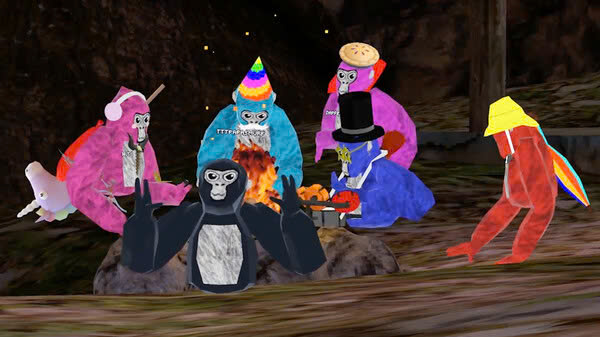
Public lobbies in Gorilla Tag are loud, chaotic, and unpredictable. Voice chat is always on. Players talk, shout, taunt, roleplay, and improvise constantly.
This can be both a strength and a weakness. On one hand, it creates unforgettable moments of spontaneous fun. On the other, it can be overwhelming, especially for new or younger players.
However, this chaos is not accidental. Gorilla Tag is designed as a social playground, not a curated competitive environment. It prioritizes freedom over control.
7. Community-Driven Culture
Unlike many multiplayer games, Gorilla Tag’s culture is largely community-created. Slang, movement techniques, informal rules, and social norms emerge organically.
Players invent mini-games, training routines, and even social hierarchies based on movement skill. You are not just playing the game—you are entering a living ecosystem.
This organic culture is a major reason for the game’s longevity. Content updates matter less than the players themselves.
8. Accessibility, Motion, and Physical Demand
Because Gorilla Tag relies on physical movement, it is not universally accessible. Players with limited mobility, small play spaces, or low endurance may struggle.
Additionally, long sessions can be physically exhausting. This is both a feature and a limitation. The game encourages short, intense play sessions rather than extended grinding.
However, for players who enjoy physical engagement, this demand becomes part of the appeal. The game feels active rather than passive.
9. Monetization and Minimalism
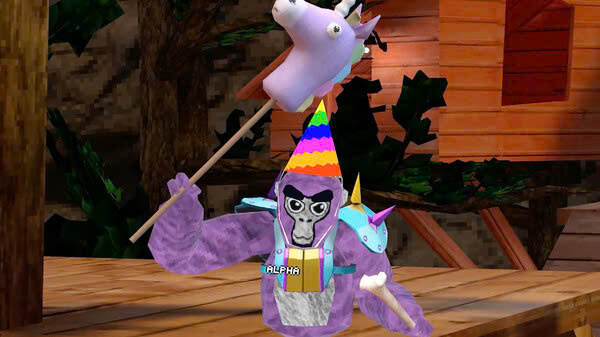
Gorilla Tag uses a restrained monetization model focused primarily on cosmetic items. There are no gameplay advantages tied to spending.
This reinforces the game’s philosophy: skill cannot be bought. Cosmetics are social signals, not power modifiers.
The minimalism extends to visuals and UI. Nothing distracts from movement and interaction. The game knows exactly what it wants to be—and refuses to add excess.
10. Cultural Impact and VR Significance
Beyond its own success, Gorilla Tag has influenced how developers think about VR interaction. It demonstrated that:
Simple mechanics can outperform complex systems
Physical engagement creates stronger immersion
Social chaos can be a feature, not a flaw
Many modern VR games now experiment with arm-based locomotion and embodied mechanics, following paths Gorilla Tag helped normalize.
Pros
Extremely high skill ceiling based on real physical mastery
Movement feels unique, natural, and rewarding
Emergent gameplay creates endless replayability
Strong social interaction and community-driven culture
Minimalist design with clear identity
Cons
Physically demanding and potentially exhausting
Not accessible to all players or play spaces
Public lobbies can be loud or chaotic
Limited traditional progression systems
Visual simplicity may not appeal to all players
Conclusion: A Game That Redefines Interaction
Gorilla Tag is not impressive because of what it contains, but because of what it removes. By stripping away abstraction, it forces players to confront space, movement, and other people directly.
This is a game about learning how to move, how to react, and how to exist in a shared virtual space. It is messy, loud, physically demanding, and deeply human.
For players who want VR to feel physical, social, and alive, Gorilla Tag is not just worth playing—it is essential.