


Among Us – Social Deduction, Trust Manipulation, and the Design of Human Behavior
Introduction: A Game About People, Not Mechanics
Among Us is often reduced to a party game about lying and deduction, but that description overlooks why it became a global phenomenon. The game’s mechanics are almost trivial: move, complete tasks, report bodies, vote. There is no progression system of substance, no mechanical mastery curve, and no complex controls. And yet, Among Us exposes something far more intricate than skill—it exposes people.
At its core, Among Us is not a game about space crews or impostors. It is a game about trust, paranoia, communication, and social pressure. It functions as a behavioral sandbox where human psychology becomes the primary system. This review approaches Among Us not as a novelty hit, but as a deliberate design experiment in social manipulation and emergent storytelling.
Quick Info (Overview Box)
Release Year: 2018
Genre: Social deduction / Party multiplayer
Platforms: PC, Mobile, Console
Game Modes: Online multiplayer, Local multiplayer, Private lobbies
Target Audience: Groups of friends, streamers, casual players, and anyone interested in social games driven by communication
1. Core Design Philosophy: Minimal Rules, Maximum Interpretation
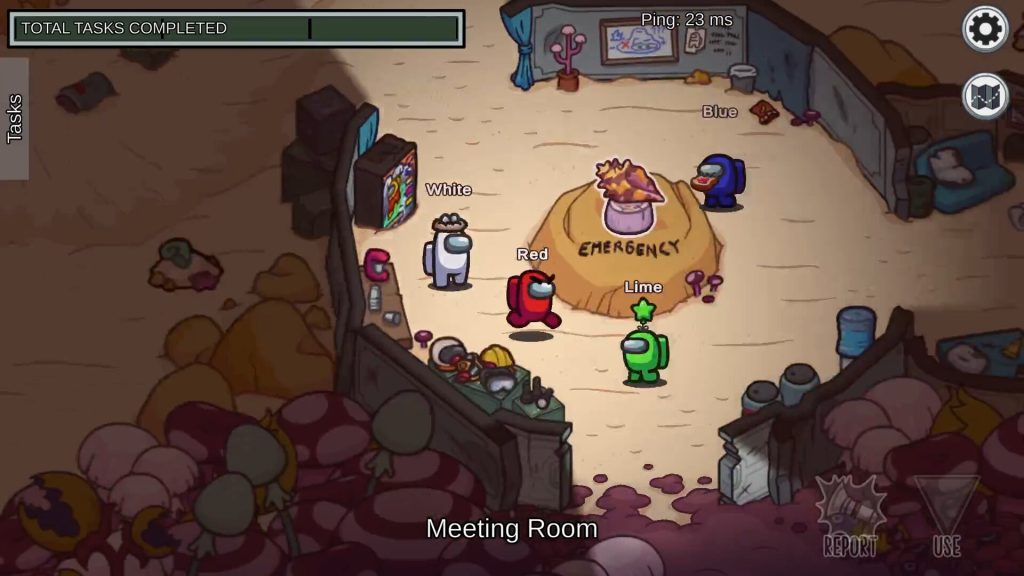
The most striking design choice in Among Us is how little it explains. The rules are simple, but their interpretation is left entirely to players. The game does not teach social norms, meta strategies, or ethical boundaries.
This intentional absence creates a vacuum that players fill with behavior. Who talks first? Who stays quiet? Who accuses aggressively? Who deflects? These decisions are not dictated by the system—they are the system.
By stripping mechanics down to bare essentials, Among Us shifts complexity away from code and into human interaction. The result is a game that feels different every time because people are different every time.
2. Tasks as Psychological Alibis
Tasks in Among Us are not challenging. Their real function is social, not mechanical. They provide players with:
Reasons to be in certain locations
Opportunities to establish innocence
Visual proof (or lack thereof)
Tasks act as alibis, not objectives. Crewmates are not trying to “win efficiently”—they are trying to be believed. This transforms mundane actions into social signals.
Impostors, in turn, must fake participation convincingly. The tension does not come from difficulty, but from performance. Every action is a potential tell.
3. Impostor Design: Power Without Control
Being an impostor in Among Us feels powerful on paper—you can kill, sabotage, and lie. In practice, it is psychologically taxing. One mistake can end the game instantly.
Impostors must manage timing, positioning, and narrative consistency. They are not just avoiding detection; they are actively shaping perception. This makes the role stressful in a way few games replicate.
Interestingly, impostors often lose not because of mechanical errors, but because of social miscalculation. A poorly chosen accusation or awkward silence can be more lethal than a bad kill.

4. Meetings: The True Gameplay Loop
The real game of Among Us happens during meetings. Everything else is setup.
Meetings compress chaos into conversation. Limited time forces snap judgments. Incomplete information encourages speculation. Social hierarchies emerge quickly—some voices dominate, others disappear.
This is where Among Us reveals its brilliance. The game does not resolve ambiguity—it amplifies it. Logic competes with emotion. Evidence competes with confidence.
Winning arguments matters more than being correct.
5. Information Asymmetry and Player Anxiety
Among Us thrives on information imbalance. Crewmates know too little. Impostors know too much. No one knows who to trust.
This asymmetry creates constant low-grade anxiety. Silence becomes suspicious. Confidence becomes threatening. Even correct behavior can be misinterpreted.
The game weaponizes uncertainty. It ensures that every player, regardless of role, feels uncomfortable. That discomfort is the engine of engagement.
6. Maps as Social Architecture
Maps in Among Us are not complex, but they are carefully structured to encourage separation and ambiguity. Long hallways, isolated rooms, and limited sightlines create opportunity for doubt.
Vent systems introduce invisible movement, reinforcing paranoia. Sabotages manipulate player flow, forcing interactions that feel unnatural.
The map does not dictate strategy—it creates conditions under which strategy emerges socially.
7. Communication: Voice, Text, and Power
The way Among Us is played changes dramatically depending on communication method. Voice chat introduces dominance, tone, and interruption. Text chat flattens emotion but increases ambiguity.
Neither is superior—they simply reveal different social dynamics. Voice rewards confidence and persuasion. Text rewards clarity and timing.
The game becomes a mirror of group dynamics. Leaders emerge. Quiet players are ignored. Accusations stick based on social capital rather than evidence.
8. Streaming, Spectatorship, and Performance
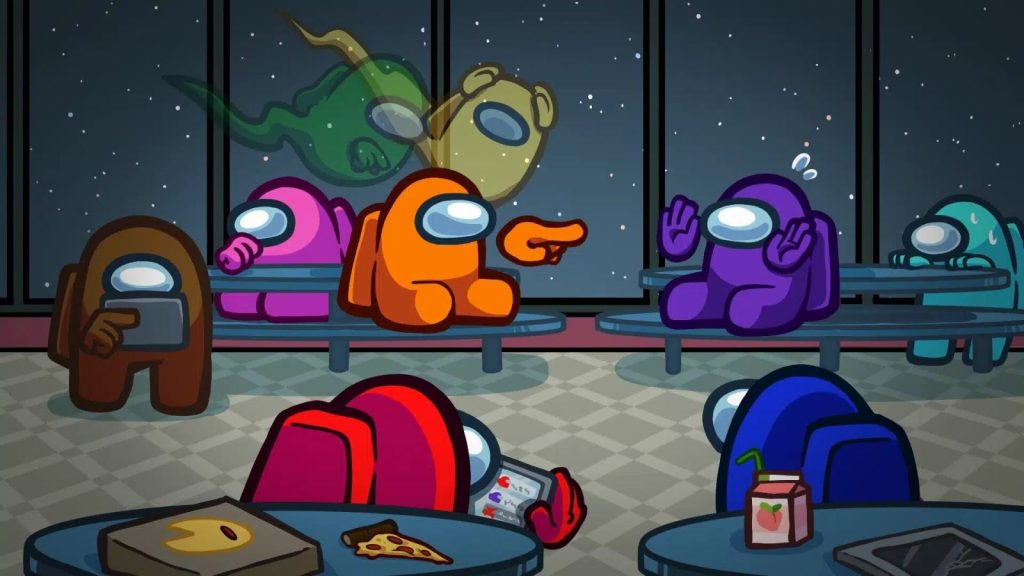
Among Us found a second life through streaming not because it is visually exciting, but because it is performative. Players narrate thoughts, react emotionally, and dramatize interactions.
This turns gameplay into entertainment. The audience watches not for skill, but for betrayal, overconfidence, and collapse.
The game’s design supports this perfectly. It creates clear emotional beats without scripting them. Every session becomes a story shaped by personality.
9. Balance, Fairness, and Chaos
From a traditional competitive perspective, Among Us is wildly unbalanced. Some lobbies are chaotic. Some are silent. Some devolve instantly.
And yet, this instability is part of the appeal. The game does not promise fairness—it promises engagement. It is less concerned with equal outcomes than with memorable ones.
Attempts to “solve” the game often strip it of its charm. Among Us works best when players embrace imperfection rather than optimization.
10. Cultural Impact and Design Legacy
Few games have demonstrated so clearly that mechanics are not the only source of depth. Among Us influenced a wave of social deduction games, but its success is difficult to replicate.
Its strength lies not in novelty, but in restraint. It trusts players to create drama, conflict, and narrative. It provides structure, then steps aside.
This approach has lasting implications for multiplayer design—especially in an era dominated by progression systems and content overload.
Pros
Extremely low mechanical barrier to entry
Deep emergent gameplay driven by social interaction
Highly replayable with different groups
Perfect for streaming and group play
Minimal systems allow personalities to shine
Cons
Heavily dependent on group quality
Can be frustrating with silent or disengaged players
Limited depth in solo or public lobbies
Balance varies widely between sessions
Repetition without social variation can feel flat
Conclusion: A Game That Exposes Us
Among Us succeeds because it does not try to control the experience. It creates conditions for behavior and lets players reveal themselves.
It is not about winning efficiently. It is about accusation, doubt, persuasion, and regret. Every match is a social experiment with unpredictable outcomes.
For players who enjoy games as human experiences rather than mechanical challenges, Among Us remains one of the most insightful multiplayer designs of the modern era.
It does not test your reflexes.
It tests your trust.